
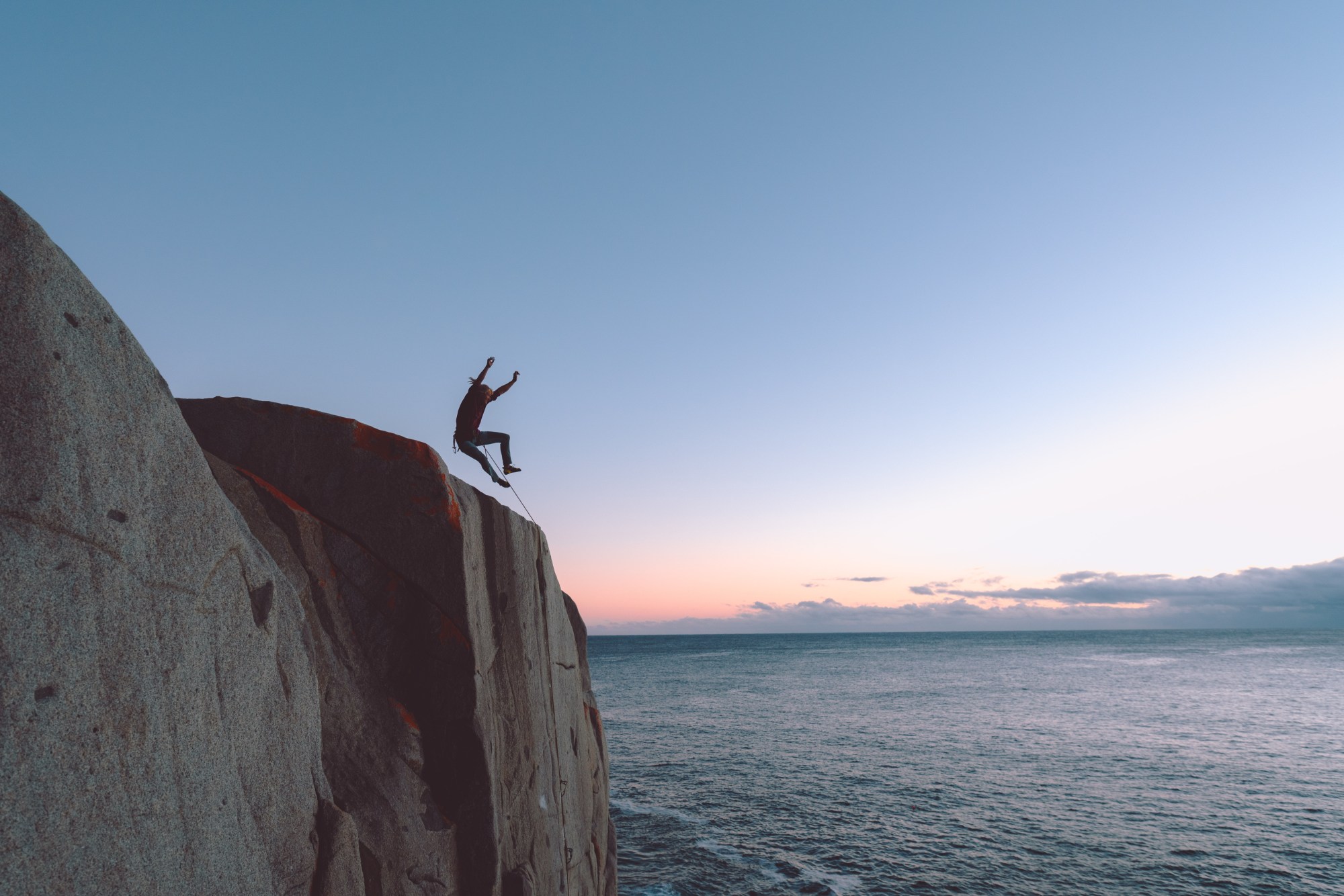
‘How is it, that after all these years, I’m still afraid of the dark?’ The thought ran through my mind as the small circle of light from my headlamp illuminated the trail stretching out into the darkness ahead of me as I walked back to the Pines one night. There are literally no predators in Australia, no bad people to be wary of, no reason at all for the sense of urgency I felt to get back to camp. There was only some raw, illogical animal instinct. It was just as dark there, yet felt safer somehow, so I rushed myself onward.
I read somewhere once that it’s human nature to fear the dark. We fear it not because of any actual threat, but because it’s in our DNA to fear the unknown; that over which we cannot control. Me? I hate not being in control. It’s a fear that’s always been a major antagonist in my life: the ever-present devil on my shoulder always telling me not to take chances, try new things, and definitely never make big commitments. In the end I usually manage not to listen, but it can sometimes take a while. When it came to doing a big international trip that had been a long-time dream, it’s why it took me thirty-one years.
It’s not like I didn’t always want to travel overseas. When I was a teenager I used to cut pictures out of magazines of destinations all around the Earth and tape them to my walls and fill my journals with them. The images and places didn’t have anything to do with climbing, but even as a kid I always knew I wanted to see the world one way or another. I’d done a few short trips to Europe before, but nothing truly immersive like a full season like I wanted; never a real commitment. That always felt like a bigger leap of faith than I was ready for, to venture that far into the unknown. It was easy not to do it when I could just drive my van somewhere closer. Thus, for quite a long time, the places I could get to by car were more than enough.
When I first moved into my van and began travelling, the entire country felt full of mystery and adventure, a blank canvass on which to write myself a story of infinite potential. I bounced from place to place, filling in each corner of the map one by one with different chapters, each so beautifully unique that I fell head-over-heels in love with the road, because never in all my life had I truly been so alive. It felt like the day that I became a dirtbag was the day my life truly began; that I had finally found who I was always meant to be.
It was easy to find the magic in those early years in the US, because the novelty of each new place and experience kept me constantly at least a little outside of my comfort zone. I never quite knew where I was going, nor what new friends or future projects would be waiting for me whenever I got there, just the right dose of the unknown that so challenged me to make it positively electrifying.
Seasons turned to years, and while my love for, and commitment to, the dirtbag life never ebbed even for a second, over time I could slowly feel that some crucial thing was becoming lost that had so inspired me at the start. Driving into Yosemite and catching that first glimpse of El Cap didn’t make me cry anymore. Saying goodbye to Indian Creek at the end of a season didn’t break my heart like it used to. Driving across Wyoming didn’t make me feel endlessly free like it once had. Even making my annual pilgrimage back to Index just didn’t hit quite the same. It was still a beautiful life, but the electricity was missing.
I had gotten too comfortable. I had driven every route between every major climbing destination in the Western half of the United States enough times to have favorite rest stops. The world felt like it was shrinking, all the blank corners of the map already filled in. I’d had all these experiences before, and that… That was completely against the point of it all.
No town nor crag could have made my stagnation more evident than when I found myself back in Bishop for the winter of 2023, a place I was now visiting for my fifth season. There aren’t that many places to go during the winter in the United States, and I had been to all of them a few too many times, though no place more than Bishop, where I’d been coming for more than ten years now. I don’t even like Bishop that much! Still, I had friends there, and the weather was worse everywhere else. I was basically only there because it was convenient.
As I watched the stories of my friends overseas clipping bolts in shorts on beaches in Europe, or climbing epic walls in South America, while I sat huddled in front of my dying propane heater in a snowstorm, the sun having long since set at 4PM, I made myself a promise: next year I would break the cycle. Next year I would buy myself a plane ticket to somewhere new, somewhere far away, somewhere where it wasn’t winter, somewhere that made me feel a bit more alive. I knew the magic I used to feel was still out there somewhere, and I was ready to travel to the ends of the earth to find it. No more giving in to my fear of the unknown and just doing what was easy.
A few months later, one of my best friends, Adrian, invited me along on his trip to Australia.
For as long as I’ve been on the road, I’ve heard stories of the dirtbag paradise of Mount Arapiles; both home to the world’s first 5.14, Punks in the Gym, established by Wolfgang Gulich in 1985, and home to some of the most legendary hangs and dumpster diving in the world. Add in Taipan Wall, recently partially reopened from the many widespread climbing bans sweeping the country, the endless sandstone of the Blue Mountains, the remote sea stacks of Tasmania such as the Totem Pole, the exotic wildlife, and the chance to visit my Australian friend Will, and I had more than enough reasons to go. It felt like fate; an inevitable pilgrimage I had always been waiting to take.
By midday on February 3rd we had arrived at the Sydney airport a group of three: Adrian, Victoria, and myself, and by that night we were at Will’s house in the Blue Mountains. Just up the street lived my friend Josh, someone with whom there was a time I had travelled far and wide, from late night rescues off the Squamish Chief to escaping Monsoons in Sedona. It had been many years since our paths last crossed, but no place is ever really too far that we hadn’t always expected to reconnect someday. Josh and his partner Zoe make a habit of rescuing joeys who lost their mothers to car accidents, so before even going climbing we had to make a stop to play with the baby kangaroos.

It didn’t take long to realize just how successfully we had left winter behind, as scorching 90 degree heat chased Adrian and I up a 50 meter sandstone pitch that afternoon. Conditions that normally would have been almost unbearable felt like a welcome treat when we knew everyone back home was freezing.
I instantly fell in love with the coarse sandstone of the Blue Mountains. Having always been an extremely tactile climber, the sensation of the textured rock under my fingertips had me fawning over every crimp or pocket I touched. Pumpy, steep sport climbing was the norm, with powerful moves between horizontal breaks ready to spit off any climber unwilling to throw a little momentum behind their movement. As Will guided us around, it became a recurring bit that when staring down a blank crux where the next hold looked impossibly far away, he would simply say, “You’ll never guess what the beta is.” It was always to jump.

The style suited me well, since steep sport climbing had been all I had been able to do for months as I rehabbed my elbow from the long-term overuse injury that had defined the better part of my previous year. It had taken many months of careful rehab and restraint, of the disappointment, turmoil, and doubt that surrounds any injury, but by now I was on my way back to normal. It had been so long since I’d been healthy that every pitch I climbed without pain felt like an incredible gift. Life was almost too good to be true.
I frequently found myself almost in disbelief at the simultaneous quantity of unbelievable things I was experiencing: the awe-inspiring beauty of endless red cliffs rising out of the mystical morning fog that settled in the gum tree forested valleys below, the daily supply of new crags and five star routes to climb, the freedom of un-injured movement and ability to try hard, and the company of some of my all-time favorite people. On a daily basis I’d find my vision swimming as I looked at the magnificent world around me, my senses awakened by the constant barrage of new sights and sounds that were making me feel like I was entranced in some sort of technicolor fever dream. I was positively vibrating from joy to be in each moment, infatuated with the one that had come before it, and excited for the one that would follow. It was that elusive knowledge that this beautiful time was simply as good as it gets; that these were the good old days, and that I was living in them right now. It was extreme passion at the strongest end of the emotional spectrum, the excitement not just to go climbing, but to simply be alive and present exactly where I was, and it was the exact feeling I had come halfway around the world searching for. Either that, or I was just tweaking from way too much Aussie tea.

I spent my time in the Blueies enjoying the opportunity to sample as much as possible, rarely returning to a pitch or even entire crag more than once or twice. Onsight climbing has always been one of my favorite things, since seldom else are you put in the position to truly have one, and only one chance to do something. Its ultimate sink-or-swim nature brings out my fiercest determination, helping me tap into a reserve of strength usually kept locked away for extreme circumstances. It’s often only in onsight climbing that I truly perform to my full capabilities. The opportunity to onsight climb in the United States has largely come and gone for me after all these years on the road, but in Australia the number of new pitches were seemingly endless, and I was thriving off it.
We had originally been planning to only stay in New South Wales (NSW) briefly before flying on to Tasmania, but a wrench had appeared in our plan to borrow a car from a local on the island. We hemmed and hawed over logistics and how to make it work, each night promising ourselves that by the following day we’d have things figured out, yet never reaching a solution. As we sat around debating one morning, completely stumped for a resolution, in through the open kitchen door walked Will’s friend Jayden like a knight in shining armor.
Jayden had a car and nowhere to be, if we could just convince him to take us to Tassie, all our problems would be solved. We tossed the idea at him, adding on that we couldn’t go climbing that day until we’d made a plan. Eager to get us out the door so he could try his project, Jayden spontaneously agreed not just to take us to Tasmania, but also to our following month in Arapiles and the Grampians. Just like that, our group of four became five, and we could finally book our ferry after almost a month in NSW.
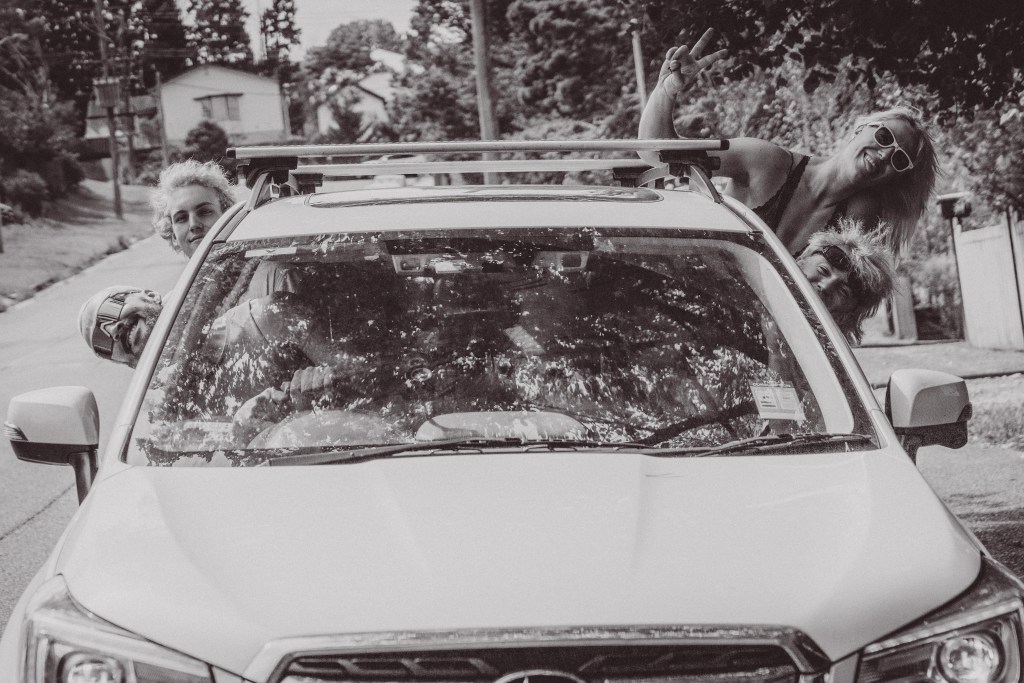
While the Blueies was single-pitch sport climbing, mostly done in caves to dodge the almost daily rainstorms, Tassie promised a vastly different kind of experience. Adventure was the name of the game now, as we prepared to leave behind the comfort of Will’s house for a month of some of the most uniquely special climbing on the planet. As we boarded the Spirit of Tasmania, our twelve-hour ferry to one of the southernmost places on the globe, Will told us stories of the sea stacks that were our first destination.
“You’re climbing this knife-edge arete at the end of the earth, with seals playing at the base and Antarctica across the horizon,” he described. “It’s simply magical.”
It certainly felt like the end of the earth by the time we finally arrived, after the three flights to get to Sydney, a train to Will’s house in Katoomba, a 12 hour drive to Geelong, a 12 hour ferry to Tassie, and then another five hour drive to finally land us on the Tasman Peninsula at 4am. Exhausted from a bout of seasickness on the Spirit and the constant dodging of nocturnal marsupials on our drive, it was a relief to finally collapse in the dirt, most of the crew to tired to even pitch their tents.
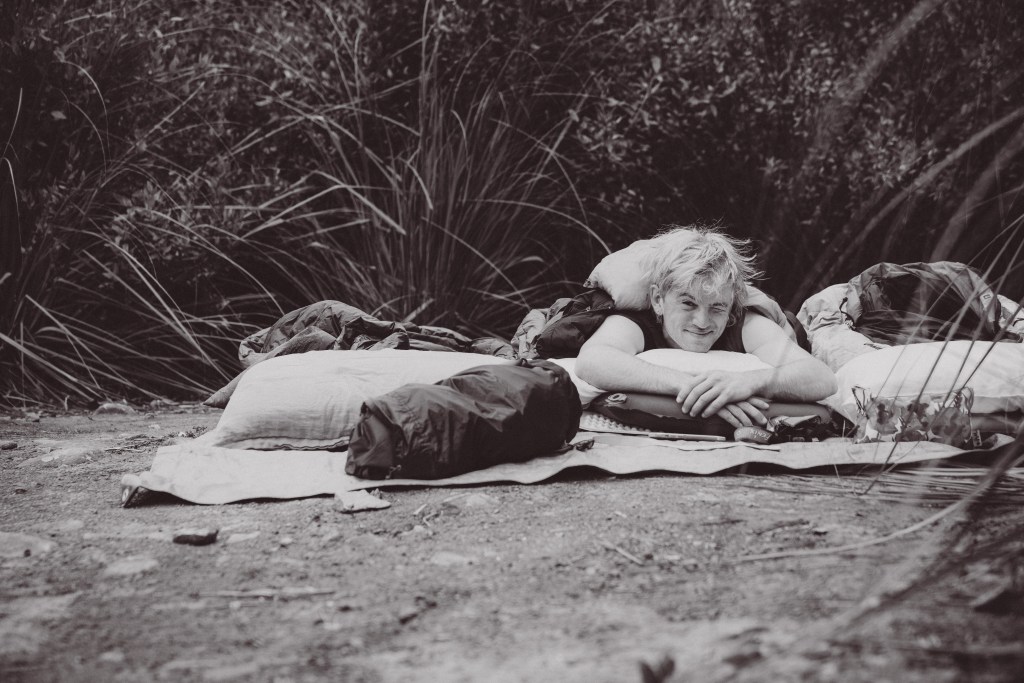
As dawn broke the next morning we blearily staggered around our makeshift camp trying to gather the wherewithal to go climbing in our sleep-deprived state. We had chosen to start with an easier objective called the Moai that offered lower-commitment sea stack climbing that you can walk to the base of, unlike the much more logistically challenging Totem Pole. Now joined by another friend, Mark, our group of six had a surprisingly casual afternoon experiencing one of the most exotic things I’ve ever done, as one-by-one we each summited the thin spire of rock jutting out of the ocean. A seasoned Tasman climber, Mark offered tidbits of tour guiding related to the area as we climbed together, telling me that these sea stacks were geologically quite young, yet would never live to be very old, only existing for a short time that just so happened to overlap with our own. It made it feel that much more of an unbelievable privilege to be there, doing this thing that so few people on earth would ever get to do.


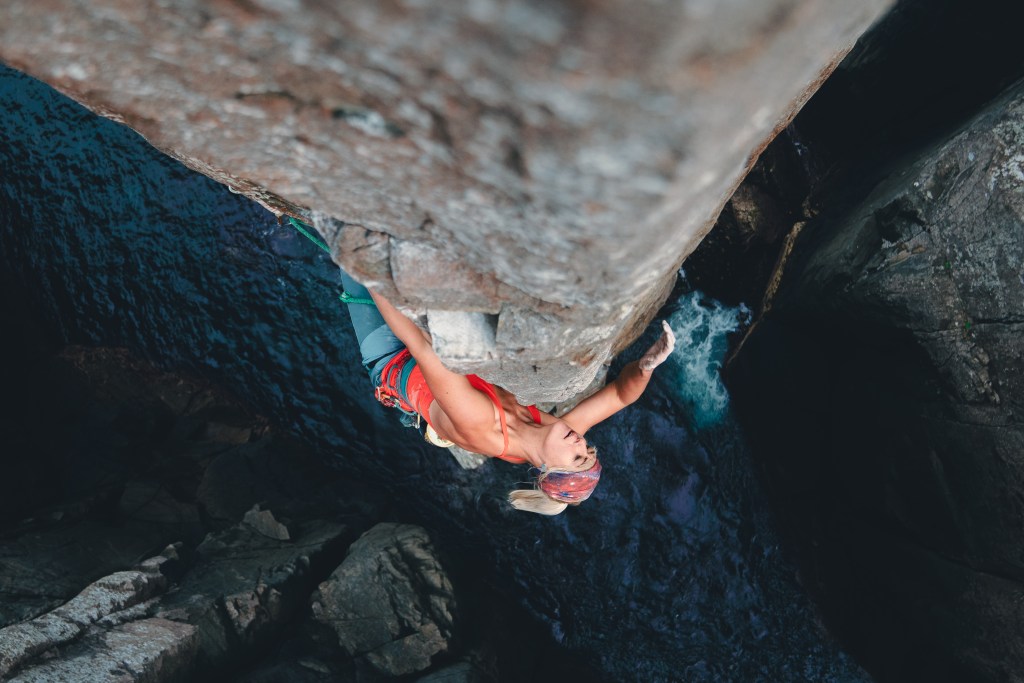
Our next day was spent on the sea cliffs of the Paradiso Wall, one of my favorite places from the entire trip. In all my two dozen years of climbing, I’ve never found rock quite like the jet black dolorite that rose straight out of the ocean, unbelievably textured despite its constant barrage of seawater that would have quickly polished most types of inferior stone. Waves three times my height threatened to sweep us out to sea as we ticked off the crag classics, creating a setting that was beautiful beyond the expression of even my most superlative language. This place… this was the stuff people wrote songs about.
While Paradiso had been paradise, what we had really come here for was the Totem Pole, an almost mythical feature unlike anything else on earth. The tower goes free at an often wet, two pitch 25 (5.12b), or a number of much harder variations. Just to get to the base requires rappelling and penduluming across a chasm of turbulent seawater where you must then dynamically clip yourself into a bolt like something out of Cliffhanger, before gravity pulls you back to the mainland. Then, even after you summit, you still have to rig a tyrolean traverse just to get off the thing. It’s just enough of a technical, physical, and logistical challenge that by the time I stood on that narrow summit I knew I was one of a very, very small number of people to have ever existed in that space. I might as well have been on the moon for how exotic it felt.
There are times that the Totem Pole is an even wilder place, with high swell days sending violent currents charging through the narrow channel where it lies, and crashing waves high enough on the tower to drench even the second pitch. On our day however, luck was on our side, allowing the seas to be calm enough one could almost have waded to the base. Despite an impending evening rainstorm, we managed to get all six of us up the Free Route, and even have time for Adrian to send the Sorcerer, a seldom climbed harder variation at 27 (5.12d). We reckoned that it was probably the most ascents in a single day that the Tote has ever seen.
By day we climbed these cliffs of our dreams, but when night fell each evening was when we truly went to war. Possums twice the size of housecats invaded our camp when the sun set each night, breaking into food bins, trash bags, and backpacks, and fighting over drained pasta water for even the faintest traces of human waste. Unused to any natural predators, even a physical shove did little to deter the pests. Wallabies (an animal similar to a mini kangaroo) were an almost equal problem if any scraps got left unattended. Seeing exotic animals had been a major draw of Tasmania, but I never would have expected them to be so invasive.
After our ticklist on the Tasman Peninsula was complete, we made a quick stop at the Organ Pipes, where dolorite columns sat perched high on a hillside over the town of Hobart. Fine grained rock nearly as dreamy as Index on its very best day formed magnificent pitches that kept us entertained until the sun went down and we continued on to Freycinet.
A tiny beach town on the eastern coast of Tassie, the climber’s camp at Freycinet became our home for the largest portion of our time on the island. Time there was divided between the white granitic sea cliffs just outside of camp, and up the long slog to the beautiful orange and yellow streaked walls of the Star Factory. On rest days or while waiting for afternoon shade we would wander down to the ocean, just a few minutes’ walk from camp, to catch a few elusive bars of cell phone service, or more often just to enjoy the serenity of watching the waves.
On one such day I left camp early in the morning whilst the others still slept, meandering down a cobblestone path to stare into the ocean that seemed to go on forever. It truly did feel like looking over the edge of the entire world. A faint ray of sun lit up a breach of waves on the horizon, but the sky was otherwise covered in a faint layer of clouds that matched the drowsy mood back at camp. The high swell of an impending storm brought massive waves crashing against the base of what normally would be pleasant seaside pitches on a fairer day; suboptimal conditions for climbing, but a mighty sight to behold on a rest day. Watching the power and beauty of the ocean, feeling the salty breeze on my dirty skin, I felt unbelievably priveleged to be here.
The previous day I had flashed a pitch that would be five stars anywhere, a 28 (5.13a) splitter finger crack called Stan up a boulder overlooking the sleepy town of Cole’s Bay and the Tasmanian ocean, in the golden hour of the last light of day cheered on by locals and friends. It was unforgettable, yet I was now one of a very small number of people who had ever done that climb, who had ever gotten to have such an experience. Out of all of the climbers in the entire world, so few would ever know what this place was like, that climb, this cliff, our campsite, yet these things were for me. I was in a state of constant disbelief. How did I get so lucky?
I frequently thought of my friends and family back home, especially my mom who loved the ocean, and my dad who would have loved all the unique types of birds. I so badly wished everyone I knew and loved could see this place and have these feelings. I thought of them, and I also thought of all the climbers I didn’t know, but who followed my travels and had big dreams of their own. Life so short and so precious, and can so easily pass by without ever making time to live it so fully. I didn’t want this to be just for me, I wanted it to be for all of them, yet most would only ever see it through a screen, or feel it through my words. It was always a bittersweet feeling, yet the chord it struck helped rekindle my desire to write about my climbing for the first time in almost two years, in the hopes that sharing my stories might inspire others out there to follow their own dreams one day.
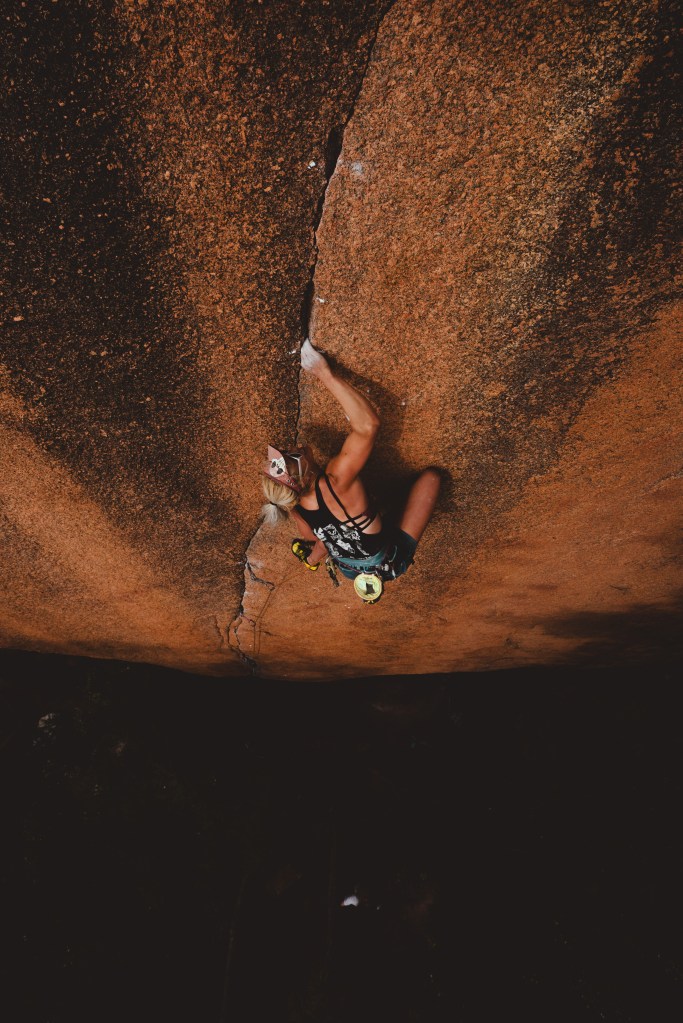
Aside from Stan, I had spent most of my time in Freycinet climbing with Mark on another crack called Augmentium, but as our numbered days drew to a close I could feel the physical nature of the route starting to bother my healing elbow. I chose to stay behind on our last day while the crew returned to the Star Factory, opting instead to rope solo by myself on a short pitch called Animal Instincts I had tried a few days prior.
Despite the climb following a crack, the locals had insisted the beta was to lieback the crux; that there was simply no way to jam your way through. I had accepted their word as gospel at the time, but had since decided that it was my new project to prove them wrong. I had spent three months in Vedauwoo to learn how to hand jam the most heinous flares in existence, after all. After an hour of swinging around on a static rope, I figured it out: high feet to flip a normal jam into an upside-down hand jam (almost like an undercling) that would allow me to pretty much just stand up and reach past the crux. It was beta that would be way more difficult for almost anyone else, but for me it made the once impossible-seeming climb suddenly feel almost easy.
After running a few clean laps on it in rapid succession, I packed up my things, lamenting that I would probably have to settle for just a top rope solo send, since I did not have a belayer. Just as I was about to leave, two Aussies came rappelling down the face next to me, done with their climbing for the day. I chatted with them briefly, wondering if I should ask for a catch. It was a bit of an exciting lead, and I had some minor doubts about trusting a stranger. That’s the excuse I told myself, but in reality I was just too shy. Maybe I’ll get someone to belay me in the dark when the others got back, I tried to tell myself. Maybe I could do it in the morning before we leave, even though it would be slippery in the sun and morning humidity. Maybe I could figure out how to lead solo. Maybe I should go back and find those guys. Maybe I should just let it go.
I’d been in a slow, ongoing process of re-learning how to fight for things over the past few months, after the previous year of injuries, heartbreaks, and setbacks had shaken my fundamental belief that the things I want are possible with enough effort, tenacity, and faith. Part of bouncing back had been learning to let go of failures without getting so shaken. Part of it had also been remembering how to put myself out there again and put up a fight. I couldn’t quite tell which situation I was in now, or in which direction taking this climb had more to teach me.
As I sat around camp mulling it over, I watched the tiny birds known as superb fairy wrens pick around our picnic table looking for crumbs. For the briefest moment one of them landed on my leg, shaking me out of one reverie, and sending into my memories of another. I was brought back in time to a day sport climbing at Equinox in Washington, when my friend Doug had been making a redpoint attempt on what would become his first 13b. As he shook out the lactic acid from his forearms on the jug before the final crux, a hummingbird the exact same color as his baseball cap flew close enough to him to touch, shocking the crew of onlookers below. Minutes later, Doug clipped the chains.
Ever since then, I’ve believed that little birds have some kind of good luck about them, and as I stared at the fairy wren in Freycinet I couldn’t help but feel like it had to be some kind of sign. A few minutes later, one of the Aussies I’d seen earlier came walking into my camp to offer me a belay.
Whatever nerves I may have otherwise had about the exciting nature of the lead were washed away by the extreme amount of serendipity I was experiencing as I sent Animal Instincts. I had been blessed like some kind of Disney princess by a bird literally called a fairy wren, only to have this very kind and handsome man come just hand me a solution to all my problems. I could not have asked for a more perfect moment.

After Freycinet we made a stop in the town of Launceston to participate in the first indoor competition I’d done in maybe seven years. It felt ironic to travel to the other side of the world, this place with the craziest and most unique features I’d ever climbed, only to end up in a gym, but at the same time it really just seemed like the thing to do. It was raining, all our local friends were going, and there had even been the promise that they had set some crack boulders just for us Americans. Mostly it was just a good opportunity to really immerse ourselves in the local community before our time on the island drew to a close.
Most of our last week in Tassie was spent hiding from the rain at a friend’s house, which despite the loss of outdoor climbing days, was a welcome recharge from all the nights spent sleeping in the dirt. For calling myself a dirtbag, all the travelling and camping had slowly been taking its toll.
I never really learned to love my tent. Despite how it was enabling my adventures by providing shelter and respite, the very thing that makes me love my van so deeply, the best I ever got it to be was merely ‘acceptable.’ It just wasn’t home like my van was, that thing that gave me just that little sense of control that I leaned on to make my constant boundary-pushing lifestyle sustainable long term. That safe, quiet, comfortable place I could go if I needed to hide; that emergency escape if I needed to run. It took a conscious effort not to feel homesick sometimes, though what I longed for was my comfort-zone as much as my van itself. I had to remind myself that this challenging feeling was exactly why I was here; the price I had gladly chosen to pay.
It reminded me in a sense of all the nights I’d spent on a portaledge, tethered to the side of El Capitan for the fourth, seventh, twelfth night in a row; filthy, exhausted, and malnourished. In those moments I’d also dreamt of sleeping in my own bed, eating normal food, being comfortable. I’d entertained such fantasies then, but quickly snapped myself back into the reality of where I actually was. I’ll spend countless nights sleeping in my bed in this lifetime, most of them identical to those that came before and after. Comfortable, yet entirely unremarkable. How many nights then, would I spend on El Cap in comparison? So preciously few that I would be remiss to take even a single one for granted, or wish I was somewhere else for more than a second. The moment I’d had that shower back on the ground, or drank that beer, I’d realize how meaningless it was in comparison to waking up on the side of a bigwall. With that in mind, I managed to reach at least a begrudging stalemate with my tent. It was enough for now, and maybe someday it would be enough for longer.
The weather finally cleared up enough to allow us a few last days at Bare Rock, a beautiful crag that would have been a highlight if we weren’t all feeling a bit run down at that point. All the packing and repacking of the trailer each time we moved, plus sharing one vehicle, food, gear, and space with four other people for so long was becoming a lot, and while we managed it remarkably well, the challenges of all our communal living had us eager to get to Arapiles back on the mainland. We were all looking forward to being in just one place for the rest of our trip, and having the independence afforded by an area where you don’t need a car, or even the people you’re with, to go rock climbing.
Compared to America, the climbing community in Australia is very small. Of all our days in the Blue Mountains, we saw other people at the crag few enough times you could count them on one hand. It was even less in Tassie, so when we rolled in to Mount Arapiles at twilight to a sea of tents, I was both excited and a little overwhelmed. Here was the legendary scene I’d heard so much about; a big part of why I had wanted to come, yet my emotional battery for being outside my comfort zone was far from at one hundred percent, and meeting new people never comes without a bit of social anxiety. For the first week I challenged myself to meet at least one new person every day, to keep the load manageable.
By the end of that first week some climbers we knew from the Blueies had arrived, as had hundreds of others for Easter, Arapiles’ biggest weekend of the year. Never in my life have I seen so many people at one campground, to the point that it felt more like being at a music festival than a crag. The nightly drum circles and highline festival only further served to reinforce the clear message: it was time to do what dirtbags do best: hang out.
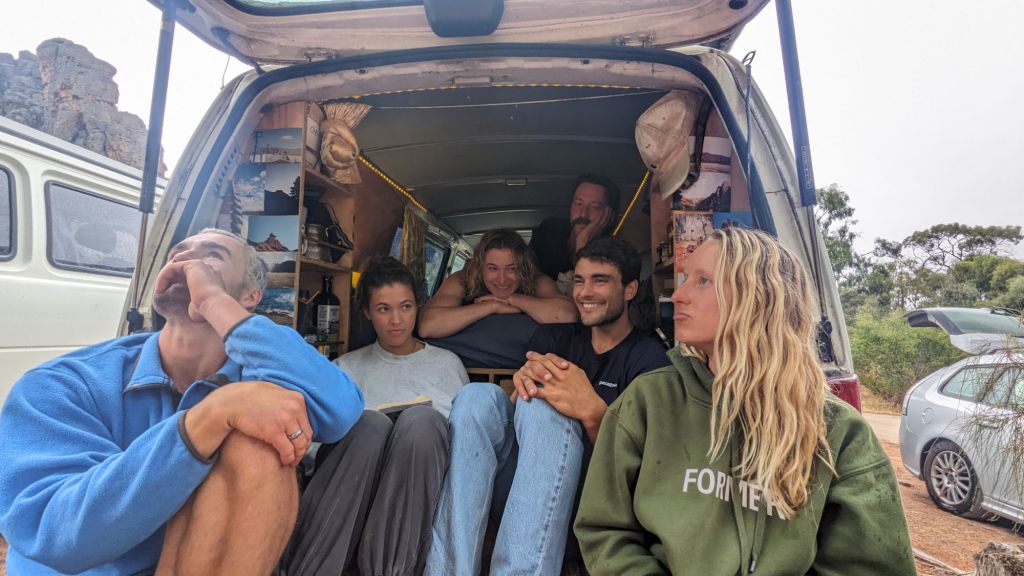
Hang out we did. We soloed easy walls in long trains of climbers, and rolled to the crags fifteen people deep. We threw raging parties and ate unbelievable amounts of food out of the dumpster. We fit a dozen people into a tent during a rainstorm, and a dozen more in a van to drive to the river when it was hot. We scrambled through squeeze chimneys in the middle of the night, and watched slackliners play during the day. We sat around for hours and hours, day after day doing absolutely nothing, yet every second of it was time well spent.
I spent many days hanging out underneath Punks in the Gym, watching others climb and occasionally trying out the moves for myself, just to see what history Down Under felt like in real life. I was not surprised to learn that Wolfgang was indeed ahead of his time with that route, as even the sight of it left me awestruck at the vision he had had, to see a new level of climbing on a wall as strangely featured as that, to be doing moves as creative as those.
I managed to spend a few days out at the legendary Taipan Wall as well, home to the famous Groove Train, Serpentine, and other routes considered by many to be among the best single pitches on the planet. Few other walls have I seen that have inspired such awe in me as that place did, bestowing an almost tangible energy upon all of us who even stood at the base. The logistics made it a bit of an errand to get to, so our time at Taipan was sadly limited, but nonetheless I cherished the adventure for what it was.
The days in Arapiles faded into each other in a happy blur, treasured moments of friendship and joy in a beautiful place of ultimate freedom spent doing all the things I love most. I cherished every one of them, but as time passed, I could feel my heart being pulled more and more back towards America. I had been away for so long, and my comfort zone battery was running on empty. My clothes were full of holes, my equipment was all starting to fail, and yeah, I missed my van. More than any of those things though, I wasn’t lost nor searching for something missing any longer. I had found what I came here for, and I knew where my life was headed next. That clarity gave me peace with knowing this incredible chapter of my life had to end so the next one could begin. I had a calling to follow, a fire that burned fiercely within me, a glorious purpose screaming my name in a language I finally remembered how to speak. I had cracks to climb.
Saying goodbye to Australia was as bittersweet as any parting ever could be, letting go of all the places and people that had given me so much. It had been everything I ever could have wanted, but all things must end in their own time, no matter how perfect. It’s a truth about the dirtbag life that I’ve always known: the static nature of the most beautifully profound experiences. It’s the same whether it’s a climbing project that deeply inspires for a time before eventually getting sent, or an exotic trip you’ve always yearned for that comes to an end: to accomplish a dream means to close a chapter and leave something behind that once filled you with passion. These things are all but singular moments in time, here now, gone shortly thereafter, and only made meaningful because they exist just once in this lifetime. To live them is to give life to a thing, knowing you have inevitably also given it death, and in doing both, giving it the power to be something truly extraordinary.
That is the poignant truth about the end of my days in Australia, for even if I am to return, it will never be the same. It’s a little heartbreaking in a beautiful sense, but it’s how it’s meant to be. While I may miss these times and the way they made me feel, I know that the only time I want to experience a rerun of my life is when it flashes before my eyes at the end of my days here on this earth. I wouldn’t want things to ever be the same. Until that final hour I’d rather keep on seeking out things that are new, things that challenge me, and things that will inevitably one day force me to again say goodbye. As much as the endings like these hurt, I wouldn’t be living my life to its fullest if it were any other way.


thanks for sharing your thoughts: so glad Victoria and all of you have been able to have these experiences
LikeLike
This was a wonder read – thanks for sharing it. And please, never stop writing!
LikeLike