

“Well, Egyptians built the pyramids.” It was said as a clever passing response in a context I’ve since forgotten, but the profound truth behind the statement created an instant mantra that, for two weeks, was recited time and time again amongst Egyptian, Spaniard, and American alike.

I’d been to the pyramids. I’d gawked and gaped and took selfies, like the tourist I am. I’d been to the museums, tombs, and temples too, stumbling through each one with my jaw on the floor in awe at the art, history, and architecture created by the ancient people of Egypt. I’d tried to wrap my mind around things like how antique the 5,000 year old mummy I was looking at really was, or how revolutionary the origin of writing on the hieroglyph littered papyrus before me actually was, but at a certain point it all felt a bit abstract; like trying to comprehend the depths of the ocean, or the vastness of the universe. With nothing but the 32 years of my life in the 21st century for reference, the impressiveness of the ancient Egyptians was almost impossible to truly comprehend.
Modern Egyptians, however, are another story.
According to AI, as of recent data, in the United States there are approximately 600 to 700 rock climbing gyms, for a population of roughly 332 million people, creating a ratio of approximately 1 rock climbing gym per 510,000 people. That probably doesn’t even include the garage in every other neighborhood with a private Kilter or Moon board.
The population of Egypt is 112 million people, nearly one third of that of the US, and yet there currently exists 1 rock climbing gym. No math is required to figure out that ratio of gyms per person. Despite hosting lifetimes worth of climbable rock, in Egypt the sport of climbing is in its infancy, accessible to few, even known about by even fewer. In the span of my two-and-a-half-week trip, I probably met the majority of the entire climbing community in the country, yet thanks to the vision of that small group of people, it’s easy to see that their climbing is teetering on the precipice of change.
I’ve long sung my praises for the visionaries throughout history, labelled as heroes those who saw climbing not for what it was, but what it could be. I’ve admired and tried to follow in the footsteps of the kind of people capable of that higher level of imagination for looking beyond the foothills of the present and instead seeing the unclimbed mountains (or unbuilt pyramids) of the future. By combing through magazines and watching classic films of the storied past of American climbing, those legends of the past aren’t too hard to find, because they paved the way for everything that exists now. As a result, in modern American climbing, visionaries are something of a rare breed. It’s far easier for most climbers to be satisfied just testing themselves against what already exists, and why wouldn’t they be? Here, we are privileged to have so much of the book on our climbing having already been written by previous generations.
In Egypt however, there are no previous generations of climbers to pave the way. In stark contrast to having some of the oldest annals of society on earth, their history of rock climbing as we define the sport today is almost nonexistent. Instead, there are just a handful of young people with a vision of what their climbing can become, and it’s exactly the kind of grandiose dream for the future that I have always so highly praised in my greatest heroes of the past. Ancient Egyptians may have built the pyramids, but modern Egyptians are no less tough, resilient, innovative, and inspired than their historic predecessors. Modern Egyptians aren’t building pyramids as monuments to the past, they are building a sport and a community to climb mountains of the future.
I arrived in Cairo knowing none of this, knowing nothing about modern Egypt, and honestly knowing very little about what I was doing there at all. I’d been told vague logistics involving packing hundreds of bolts into the mountains on the backs of camels, and promises of bucket-list sight seeing in a very new part of the world to me with some of my very best friends during a time of year when I most like to travel, so I’d immediately said yes.
As my flight began its descent into the Egyptian capitol, city lights stretched out as far as my sleep-deprived eyes could see in every direction and I had my first inkling of just how foreign of a world I was about to enter, having never been to the Middle East, Africa, Asia (Egypt spans both continents), or even a city a fraction of as big as Cairo, home to over 22 million people. It must have been obvious how out of place I felt, because the customs agents took one look at me and my white hair and colorful luggage and immediately pulled me aside to more thoroughly question me and search my bags before I was finally allowed into the country.

I was met outside the gates by two strangers who instantly welcomed me like I was an old friend as they drove me across town to Sherif’s house where myself, Sam and Mary, the three Americans, plus Talo, Mario, and Karina, the three Spaniards in our group, would be hosted.
As we swerved in and out of traffic, the first thing I learned was how there are essentially no traffic laws nor police, and that non-Egyptians rarely drive in Cairo. The dotted lines meant to mark lanes are ignored, as are any other rules, instead being replaced by a language of audio signals created by different patterns of horn honking that sound like words or phrases in Arabic. The result is an ever-present chaotic cacophony anywhere you go, where backups are as likely to be caused by random pedestrians ambling across the highway without a care in the world as by accidents, and camels and horses towing carts of goods have as much a place on the roads as cars. I was even involved in a collision in an Uber during my visit, yet all that happened was that the two drivers exchanged a few heated words, pulled the dents out of their cars by hand, and both went their separate ways as if nothing had happened.
The first to arrive by an entire day, I had time to explore the incomprehensively massive city as our hosts and I waited for the much-delayed flights of the rest of our crew to arrive. Once all the foreigners were finally assembled, we paid a visit to Cairo (and all of Egypt)’s only climbing gym, Ascent, where we had the opportunity to teach a brief clinic on the types of climbing we each did best: crack for the Americans, and slab for the Spanish. In that one night we met what was likely the majority of their community, and learned that many of them were to accompany us out to where the real rocks were the following day.
Despite having only been climbing a short while since the gym opened, all of the climbers we met were already quite strong, yet humble and insatiably hungry for more. Watching them place their first ever hand jams, and then enthusiastically try the foreign motion over and over until they got it right immediately warmed my heart to their stoke.

Now connected to the small yet tight-knit community, the next day we piled our heavy loads of drills, bolts, ropes, and camping gear into a few cars and headed out towards the mountains for the real reason we were here. While 95% of Egypt’s population lives along the Nile river and its delta, where we were going was Sinai, the peninsula that acts as a land bridge between Africa and Asia (and is the part of the latter that makes Egypt a trans-continental country). To get to Sinai requires crossing the Suez Canal via a tunnel that gets treated as seriously as an international border, with numerous police checkpoints at which we were required to stop and have our passports inspected. We were told to simply say we were going on a hiking trip if questioned (a popular source of tourism thanks to the historic and religious significance of Mount Sinai, where in the Bible Moses received the Ten Commandments from God), and that if the climbing gear was found we might not be allowed through, since they are likely to simply reject that which they do not understand, but no such conflict happened.


After driving south along the coast of the Red Sea for an hour or two, we eventually left the beaches in favor of the sandy plateaus to the East which eventually gave way to the rocky hillsides that quickly rose into the much higher mountains of the 600-900 million-year-old granite of the Arabian-Nubian Shield that makes up Saint Catherine, our destination. In the town of Saint Catherine, we left our cars behind and turned over our bags and gear to our Bedouin guides, essential native hosts that must be hired and are a privilege to be hosted by in order to visit their lands. They treated us to tea as they packed our heavy loads onto the camels that would act as our sherpas, and eventually we all set off on foot to go beyond where the roads end and the climbing can begin, out of sight of those who would not approve because they do not understand. There, the conservative Egyptian government no longer has control because it cannot be accessed by car, and instead the land belongs to the different Bedouin Tribes who allow us climbers to play on the endless rock faces so long as their way of life and land is respected.


We camped in an old Bedouin village, made up of simple yet sturdy structures of stone and straw, and had all our food prepared by hand over a campfire by our guides, while we ventured deeper into the mountains each day to explore and develop new routes. Climbing in the region has existed there for decades, but only traditionally and established by foreigners like the occasional British visitor. That style unfortunately creates a very high barrier to entry to a young climbing community, since it requires expensive trad gear that is made even more expensive by import taxes in a country with no climbing retailers. Additionally, needing the technical skills of crack climbing, placing trad gear, building anchors, route finding, and self-rescue all make for an area where beginners don’t have very easy access to the outdoors.
All that changed only a few years ago, when Sherif saw the potential for sport climbing on the endless slabs however, and recruited Talo to teach the community how to bolt. Ever since, the area has been quickly becoming a slab mecca with hundreds of bolts being placed by the Egyptians and Spanish alike every season, allowing climbers of all levels of expertise to now test their mettle in the outdoors.
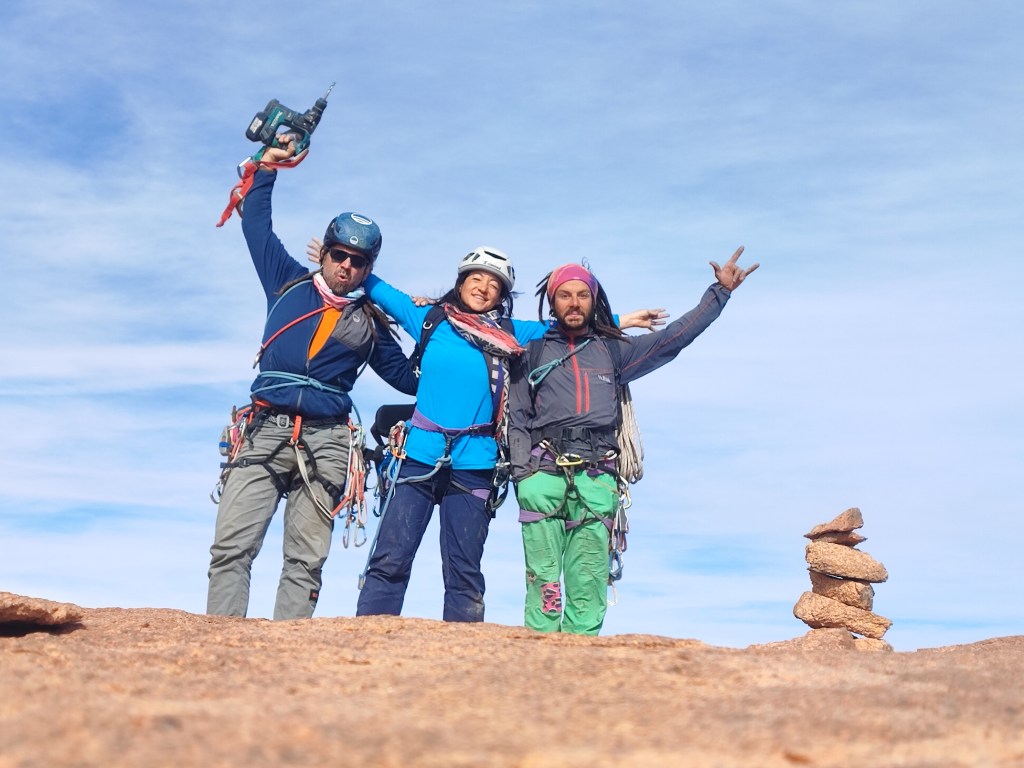
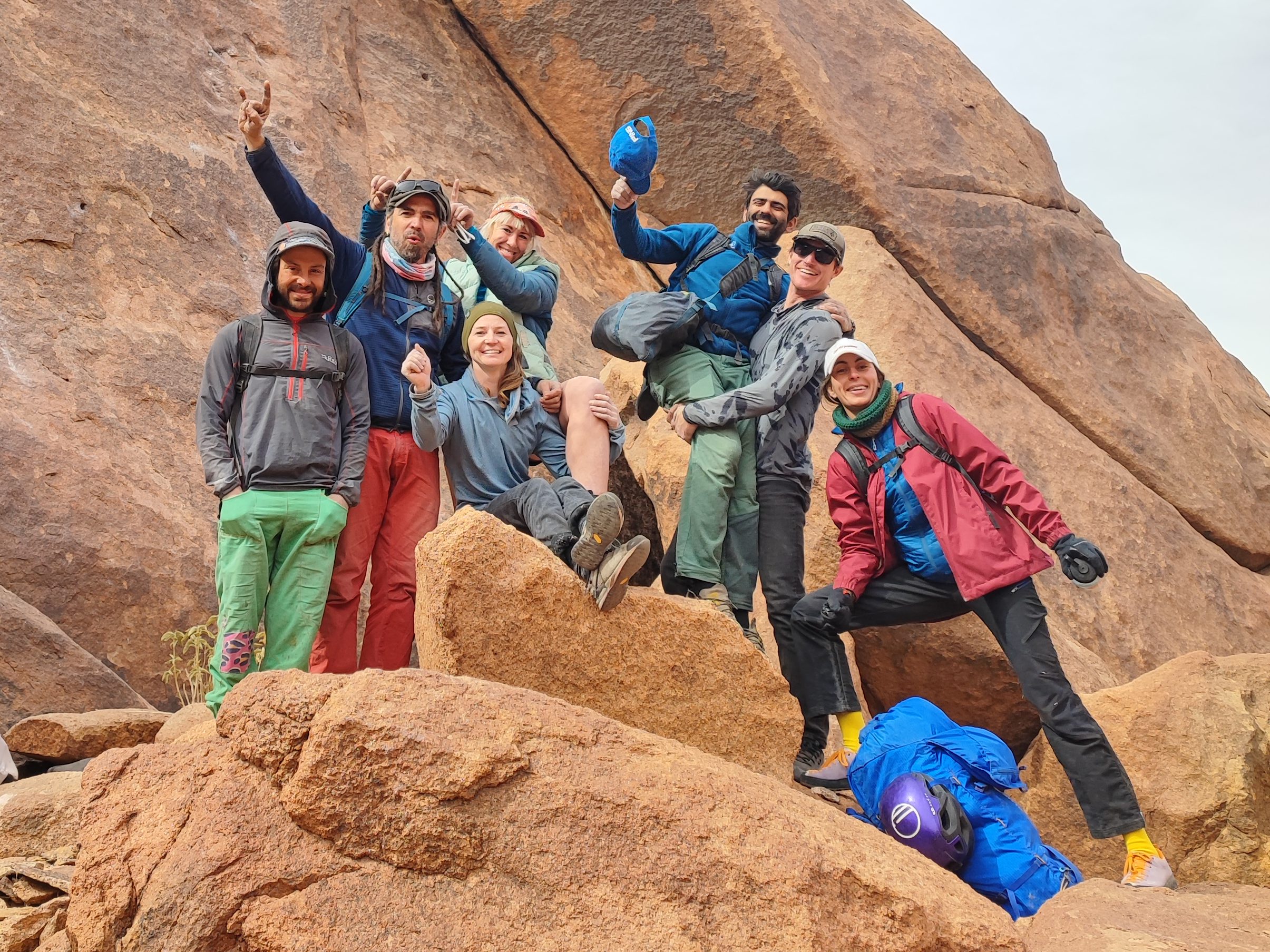
Upon learning the origin and current status of the area’s development, Sam, Mary and I agreed that our time here would be best spent not developing hard routes for ourselves, but easy to moderate climbs that would further this goal of increasing the accessibility to the community and thus helping facilitate its growth. While the 5.14 slab climbing Spaniards pushed the cutting edge of difficulty, we did our best to open the area on the other end of the spectrum, so that together we could provide something for everyone. Some of the Egyptians joined in on the bolting, while others helped us test out our routes, allowing our entire group to work on many things at once. In the week of development we did, over 300 bolts were placed, multiple entire new crags were opened, several people climbed their hardest routes or first outdoor leads, and we even got our Bedouin guide to climb a pitch.
Sam, Mary, and I spent most of our time working together as a team, with our proudest contribution being an entire crag of 6 new routes all in the 5.9-5.11+ range that are now the easiest bolted climbs in Saint Catherine.
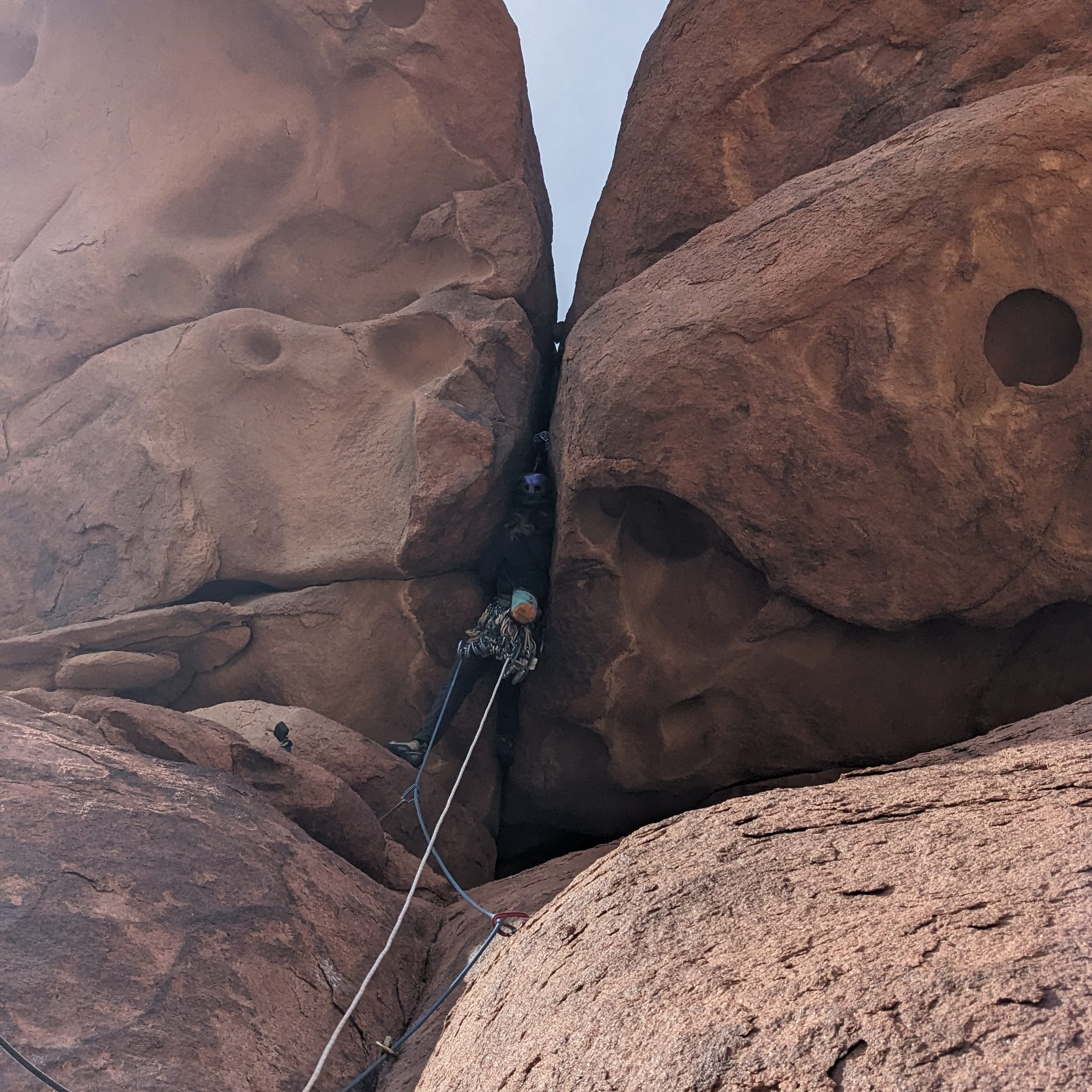
After so much slab climbing however, on our last day in the main area we decided it was time to add a little crack climbing contribution to the area too, for those seeking a bit more adventure. We had looked high and low for splitters and come up empty handed, but if there’s one kind of crack that can be found just about everywhere it’s offwidth, and if there’s anyone good at finding and establishing good ones, it’s Sam and Mary. They had spotted a wide roof crack high up on a wall, and we made it our last goal of the trip to try and get up there and climb it.
The route followed an existing old trad climb for the first pitch, before venturing into new terrain where a number of bolts were required to navigate a technical flare. That brought us to the short, wide roof, that presented a different challenge for each one of us thanks to our varied sizes of hands, arms, and legs. Mary styled through it first with hand fist stacks and chicken wings, before it was my turn. As I racked up for the next go, Mary offered to let me borrow her crack gloves since I’d forgotten mine and the backs of my hands were already bleeding from some disgustingly flared hand jams I’d used on the previous pitch. I miraculously managed to fit most of my extra-large hands into her extra small gloves, but the inflexible leather somewhat limited my movements. It was a sacrifice worth making to save my skin, but the result was that I could not follow the route in her same style since I couldn’t quite make a fist with the restrictive gloves. After sliding out in frustration, I reconsidered my options and decided to try and invert. After nearly ten minutes of groveling for a few inches of upward progress out the very short roof, I finally managed to right myself, succeeding in climbing my first 5.12 offwidth. Sam went last, opting not to use Mary’s crack gloves and succeeding in using the fist jam I could not, and was at the chains before he even broke a sweat. Thus in one afternoon we established Egypt’s hardest crack climb, a record that would almost immediately be broken just one day later by Mary.
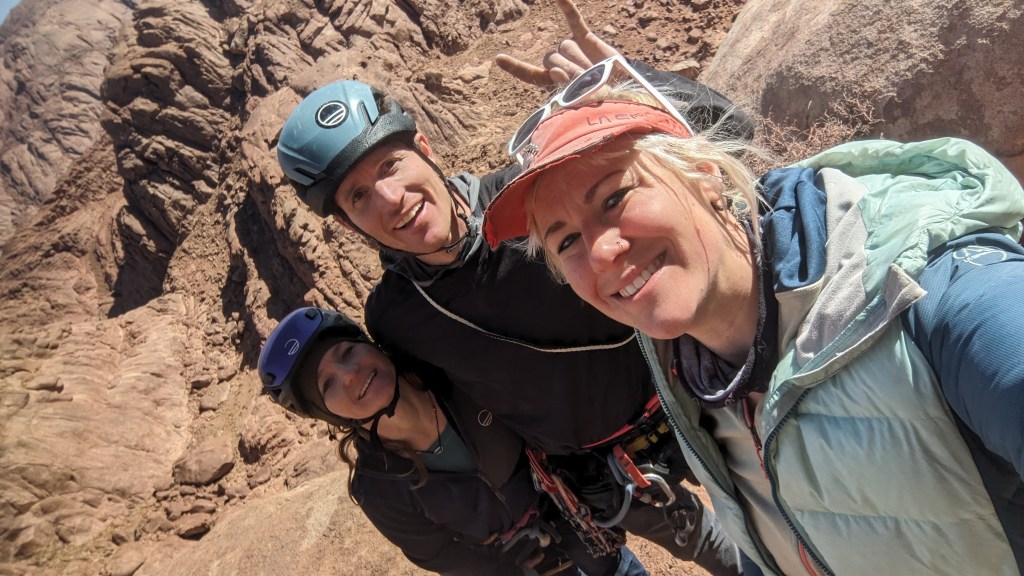
Our trip had an expiration date thanks to the arrival of the start of Ramadan, not to mention that in a week of hiking, climbing, and bolting, almost no one had taken a single rest day. For our final excursion we ventured out into the Plateau of Hallaoui, where there was climbing with supposedly no approach, to adapt for an injured member of our party.
New permits were required to traverse the land of a different Bedouin tribe, before we could all pile into a van to leave Saint Catherine. Once through a police checkpoint we transferred into the open backs of two rusty pickup trucks and flew off into the almost Martian landscape. Whereas before we had been surrounded by rocks and mountains in every direction, this new local was more akin to valley floor, with flat plains dotted by occasional rocky outcroppings allowing our drivers to go where they pleased on and sometimes off of what were only the faintest suggestions of roads.

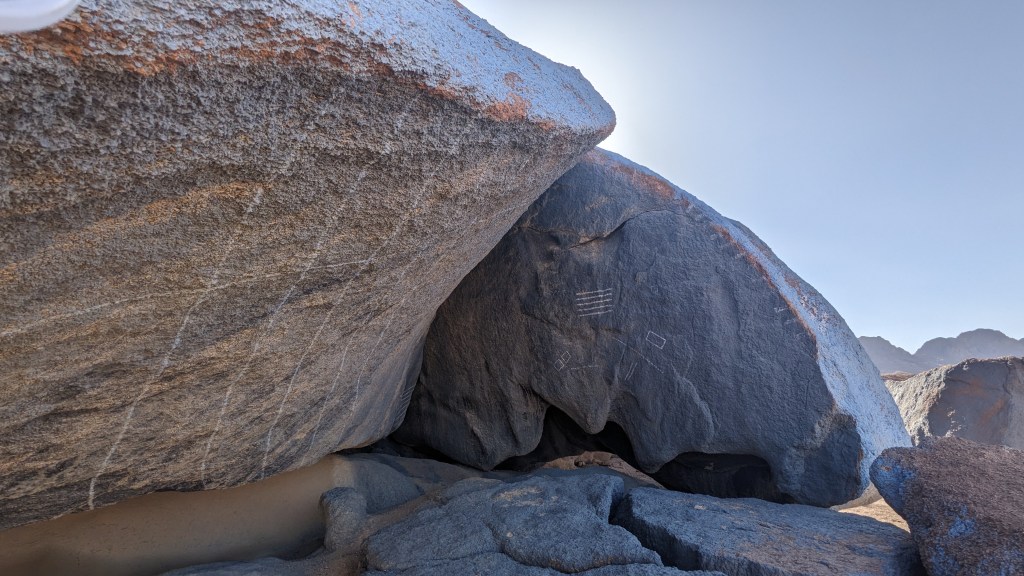
While we entertained ourselves by staring at all the potential climbing areas and occasional wild dromedary (one-humped camel) as we passed them by, our drivers and guides tested the limits of what the trucks could handle for fun, occasionally trapping us in deep sand and requiring some pushing and tire deflation to escape. The further into the wild we ventured, the more we started to see the reddish-brown rocks turning an unnatural shade of blue; paint, we were informed, from an old art exhibit.
The Blue Desert, as it is called, was created by Belgian artist Jean Verame in 1980 using paint donated by the United Nations following the historic signing of the 1979 Egypt-Israel peace treaty, where Sinai was demilitarized and returned to Egyptian ownership. The color blue is meant to signify peace and the hope for harmony in what has been a historically conflict-stricken battleground.

After stopping numerous times to scout out different potential crags for the day, we eventually agreed upon our destination and set to work looking for unclimbed slabs and cracks. While the climbers did their thing, our guides went about preparing an elaborate lunch, chopping salads, and roasting eggplants over the fire to be made into a dish eaten on Egyptian bread, which had likely also been made over a fire a day or two beforehand.

With a few last pitches established in this new area and with the sun rapidly dipping below the horizon, we piled back into the cars, jump started their engine batteries that had been killed from playing music during the day, and hauled ourselves back to Fox Camp, our refuge in the town of Saint Catherine. We enjoyed one last local meal at a Bedouin restaurant, where stray cats hid under the table and begged for scraps while we toasted to all that had been accomplished in just a handful of days.
Mary had freed Egypts hardest crack climb, Talo and Mario had put up a new 5.14 slab, countless new 5.13s, and a ten pitch route up the entire Abu Mahshour dome that was now the area’s longest multipitch, we had opened an easy-to-moderate crag for beginners, bolted anchors on existing trad climbs to make them accessible, established a hard offwidth multipitch, encouraged some of the local Bedouins on a few of their first climbs, and watched many of the Egyptian climbers accomplish their climbing goals and send their projects. Never in my 25 years of climbing had I seen so much climbing history being written all around me in such a short period of time, and the view was almost blinding.

Like I said, ‘Egyptians built the pyramids.’ This incredibly rapid growth that had been accomplished in, what would be the blink of an eye in the history of the region, should all be credited to them. It was the Egyptian climbers who dreamt up the idea of making this place into their outdoor climbing destination, them who sought out the resources to learn to develop it, them who invited us to visit and help support their mission, brought us into their homes, their culture, and their communities, and them who will continue to carry that bright torch forward from here.
It’s easy to see that the story of Egyptian rock climbing is being written in real time, right now; that the climbers who will go down as the defining pioneers of their sport are the people leading the charge today. To even be briefly along for the ride, let alone to have been able to offer support in the form of sharing my own knowledge and skills, was nothing short of an honor. Each one of us may have laid a brick in what will one day be Egypt’s next great pyramid (metaphorically speaking), but the ones that started and will surely finish it, were the Egyptians.
Few Western climbers will have ever heard anything about climbing in Egypt before now, and to plan a visit without local knowledge and hosts, or the ability to speak Arabic at the very least would present far more of a challenge than your standard climbing expedition, but like I also said: the sport of climbing in their country is on the precipice of change. The psyche of the Egyptian climbers is an unstoppable force, and to those paying attention, I would bet good money that it won’t be long until we will watch the area transform into a world class destination thanks to the hard work of some of the most visionary climbers I’ve ever met.
 brittanygoris.com
One thought on “Egyptians Built the Pyramids”